Research
“A sense of curiosity is nature’s original school of education”
Smiley Blanton
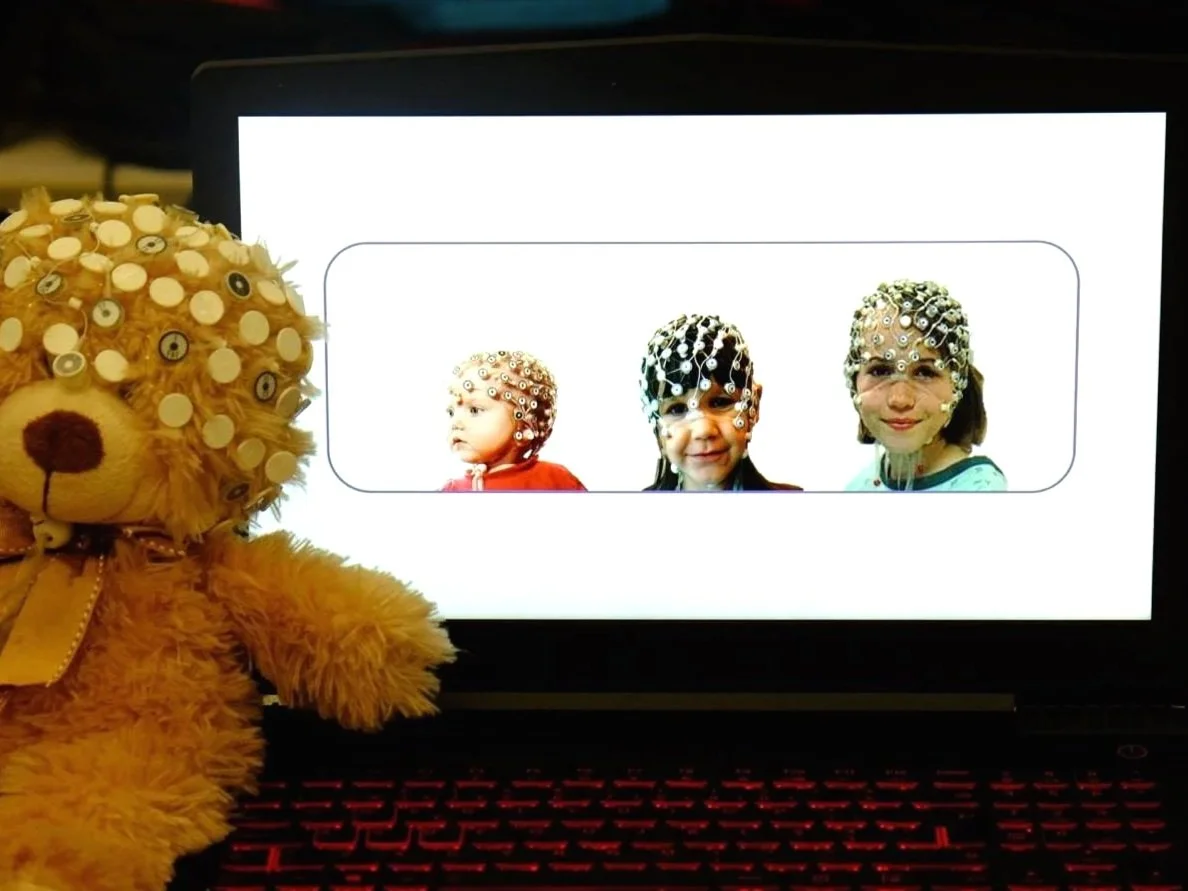
Research was my gateway into academia. Driven by a deep curiosity about the human brain, particularly its development and interplay with mental health, I began my journey at the Lab. Neuropsychophysiology at the University of Porto (Portugal), where I specialised in Electroencephalography (EEG) and used this technique to investigate electrical brain activity across diverse populations, contexts, and processes. As a Research Assistant and later a Research Fellow, I contributed to projects ranging from the impact of neurofeedback for cognitive training in older adults, to exploring how individual differences and life experiences shape emotional processing in both children and adults.
My PhD project between the University of Porto and University College London wove together many of these threads. Being awarded with a grant from the Portuguese Foundation for Science and Technology, I examined how our capacity to perceive and interpret facial expressions of emotion develops from infancy to adulthood, applying contemporary predictive models of brain function to illuminate this process and using neuroscientific and behavioural methods.
Currently, my involvement in research continues through supervision and collaboration. At University College London and the Anna Freud Centre, I work closely with MSc and MRes students, supporting their projects in the fields of child mental health, brain development, and play using both quantitative and qualitative approaches. These collaborations provide me with valuable opportunities to mentor young academics, exchange ideas with peers, and keep my own teaching grounded in current research.
Ongoing projects:
Experiences in establishing a therapeutic relationship with non-verbal children
The development and precursors of pretence capacities from infancy to preschool age
Is all play the same? Analog vs. digital play experiences in children and adolescents
Understanding children’s experiences using a sand tray and an adapted interpretative phenomenological analysis
Short- and long-term impact of videogaming in brain responses to affective stimuli in adolescents
The moderating role of desensitisation to affective stimuli in the relationship between videogaming and sexism in adolescents
Children’s experiences of navigating primary school transitions in the UK
Predictive processing models of play and therapeutic play